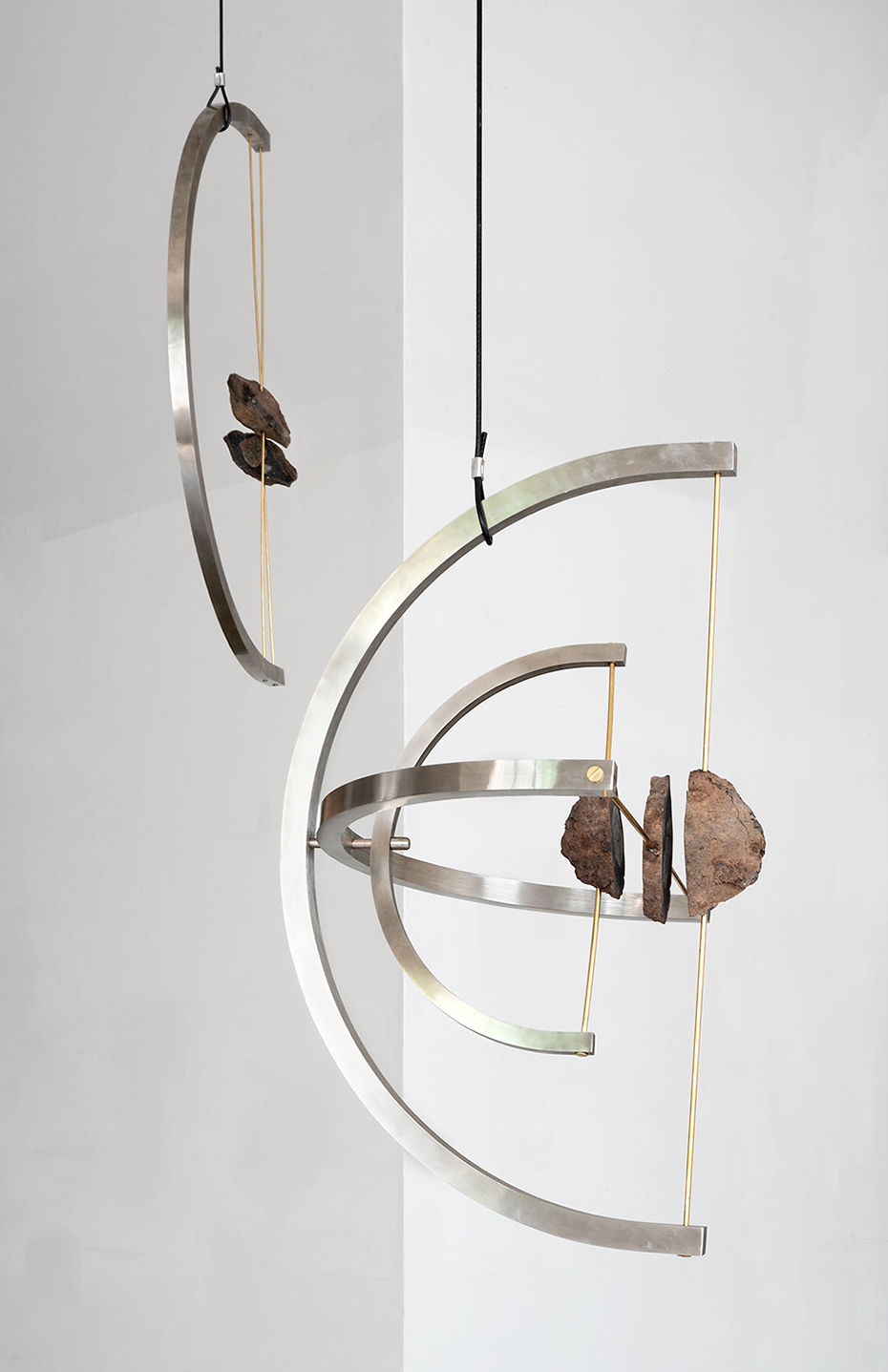
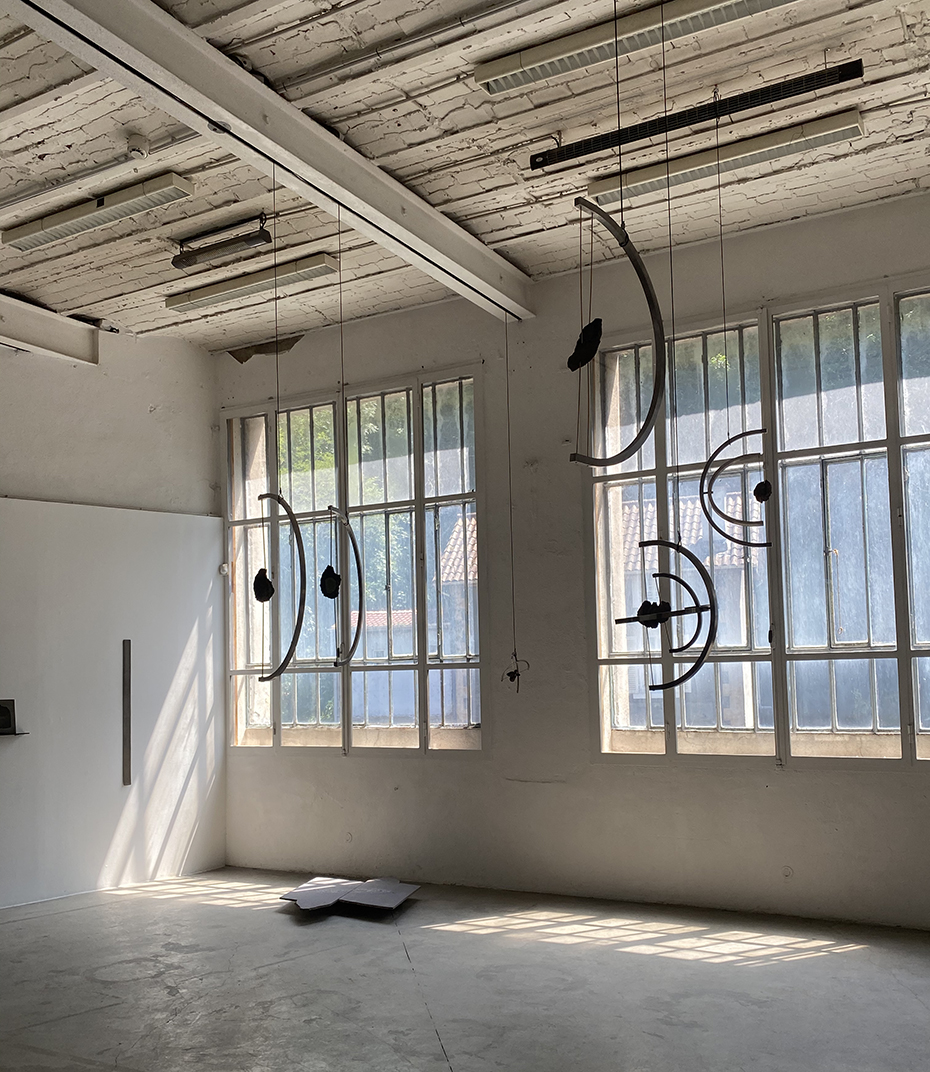
Montées sur des structures métalliques, des « bombes » – fragments de roc solide et de magma pâteux projetés pendant l’explosion, empreintes formées par la puissance de l’air, de l’eau et de la terre – sont exposées sous une forme dite « éclatée ». Cette technique de représentation d’un objet complexe en montre les éléments invisibles par séparation. Leur structure interne fait apparaître des couches du manteau terrestre, elle permet de reconstituer l’ensemble du mécanisme dont elles sont issues : fluidité du magma, vitesse de leur ascension dans la cheminée du volcan, orientation du champ magnétique local.
Marguerite Pilven
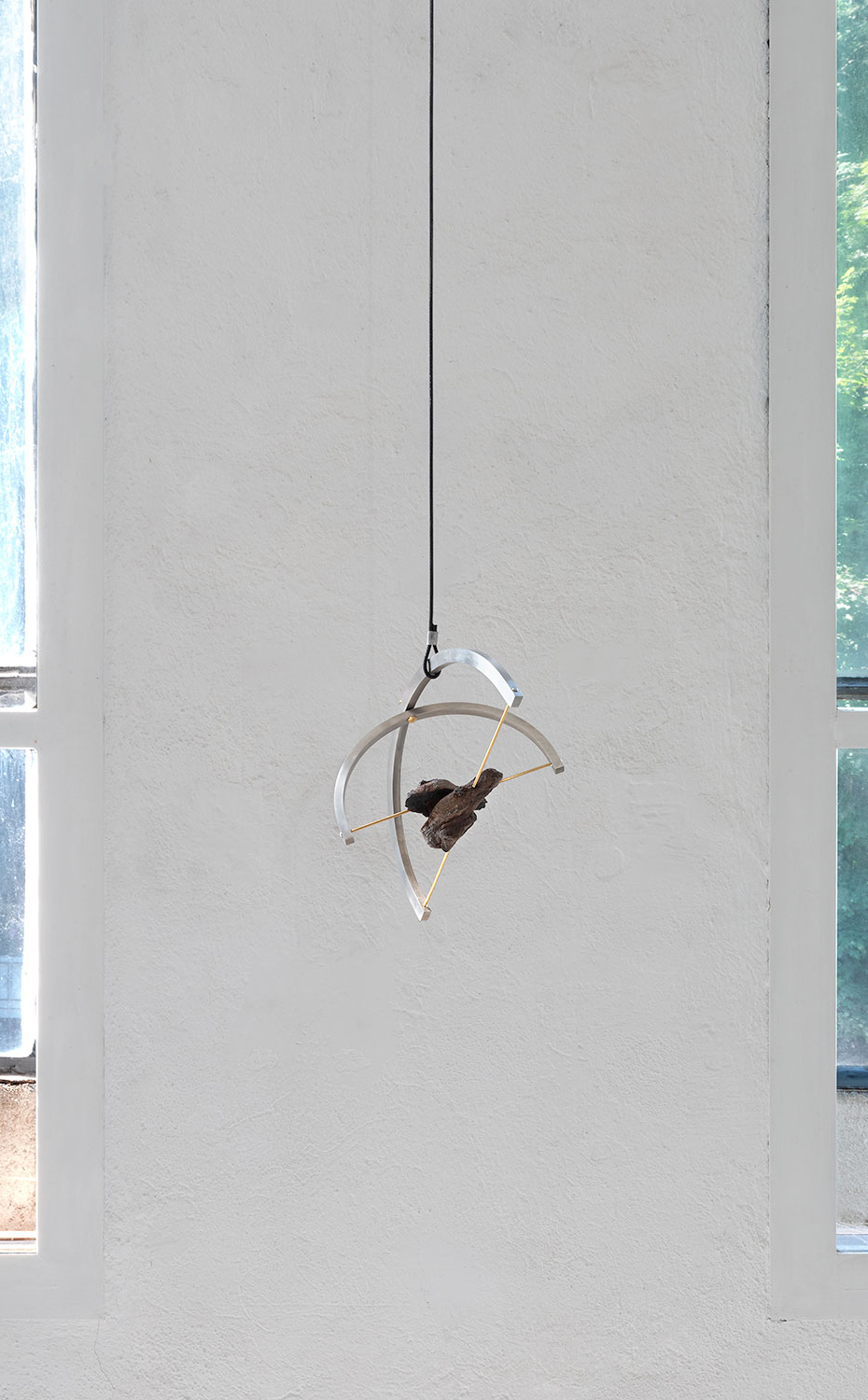
Chaque Aérolithe est composée de deux structures en demi-cercles en inox massif, reliées par un pivot central. Ce pivot amène une mobilité permettant différentes ouvertures et positions de l’oeuvre.
Une bombe volcanique est coupée en deux car on peut lire l’histoire de la Terre dans une pierre comme dans un livre. Chaque morceau est maintenu par une tige en laiton le traversant, et la tige est reliée aux 2 demi-cercles.
L’ensemble est un assemblage mécanique proche de l’orfèvrerie : rien n’est collé. La forme de l’oeuvre est inspirée des sphères armillaires, instrument ancien employé en astronomie pour modéliser la sphère céleste et dévoiler le mouvement des étoiles et du Soleil autour de la Terre. La légèreté de cette forme permet d’observer la particularité physique de la roche (issue du Mont Coupet, en Auvergne), dont le noyau est une péridotite, et qui a été façonnée par l’air au cours de son éruption (créant un trouble sur l’identification à première vue d’une météorite). Présenter les bombes ouvertes en deux permet de révéler la particularité de l’éruption du Mont Coupet : la lave amenait avec elle une partie du manteau supérieur, ce qu’on appelle une péridotite.
Assembled on metal structures, « bombs » – fragments of solid rock and pasty magma projected during the explosion, shape born from the impact between air, water and earth – are exhibited in a form designated as « exploded ». This technique of representation of a complex object shows its invisible elements by separating them. Their internal structure reveals layers of the Earth’s mantle, and allows us to reconstruct the entire mechanism they stem from: the fluidity of the magma, the peed of their ascent in the volcano’s chimney, the orientation of the local magnetic field.
Marguerite Pilven
Each Aérolithe is composed of two semicircular structures made of solid stainless steel, connected by a central pivot. This pivot allows for mobility, enabling the work to be opened and positioned in various ways.
A volcanic bomb is cut in half for the History of the Earth can be read in a stone just as it can in a book. Each piece is held in place by a brass rod passing through it, and the rod is connected to the two semicircles.
The entire piece is a mechanical assembly reminiscent of fine metalwork: nothing is glued. The work’s form is inspired by armillary spheres, an ancient astronomical instrument used to model the celestial sphere and reveal the movement of the stars and the Sun around the Earth. The lightness of this form allows one to observe the unique physical characteristics of the rock (from Mont Coupet in Auvergne), whose core is peridotite and which was shaped by the air during its eruption (making it difficult to identify as a meteorite at first glance). Displaying the bombs split in half reveals the distinctive nature of the Mont Coupet eruption: the lava carried with it a portion of the upper mantle, known as peridotite.
Crédit photo : Vincent Blesbois