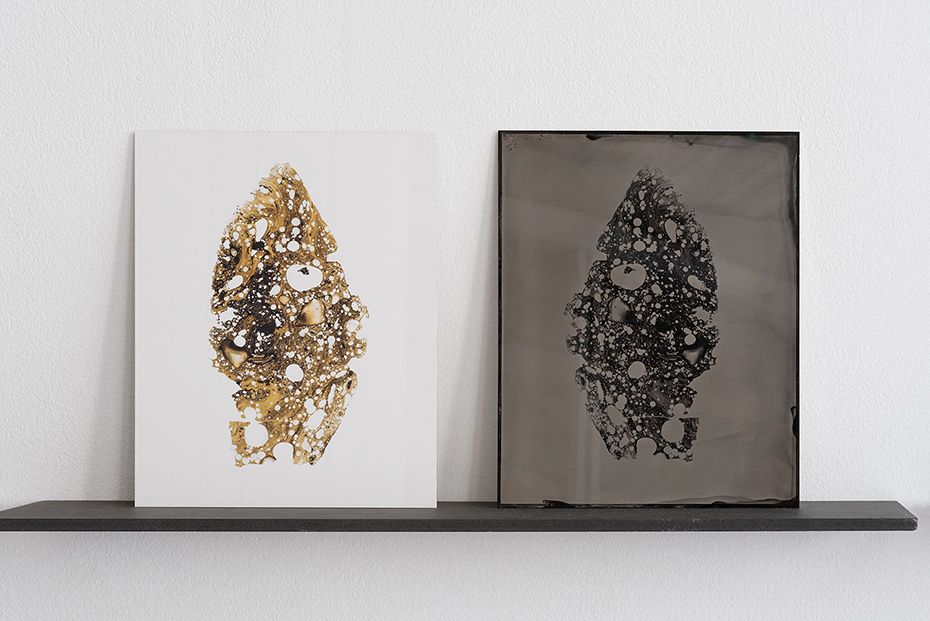
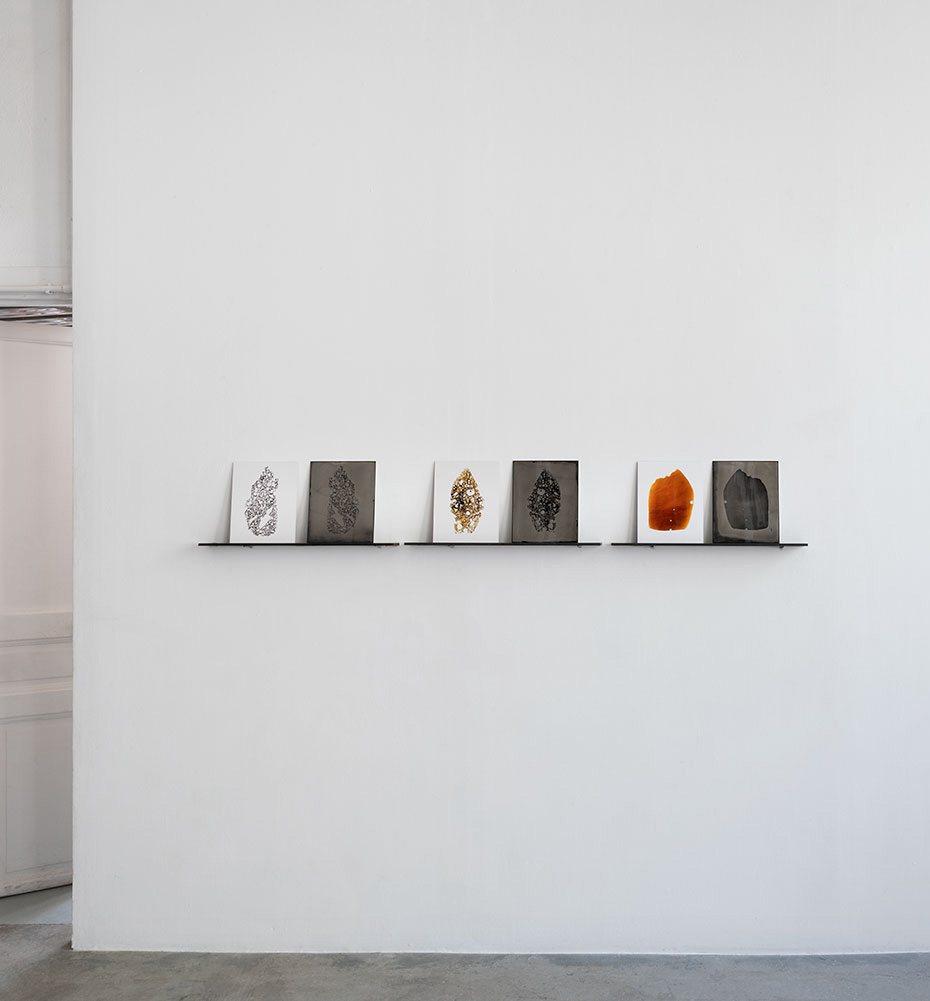
La série des Lames minces, réalisée en 2021, propose une incursion au cœur de la matière.
La série est composée de trois diptyques en miroir qui évoquent, à la façon des tests de Rorschach, la promesse d’un livre ouvert —car on peut lire l’histoire de la Terre dans une pierre.
L’œuvre rassemble trois impressions de lames minces réalisées à partir de trois échantillons de lave : de la pouzzolane brute, puis de la pouzzolane fondue à 1150° (dans une forge à charbon), et enfin à 1200° (dans un creuset de fonderie). Ces lames, utilisées pour observer la structure interne des roches, donnent à voir en coupe les alvéoles et les cristaux qui composent la matière volcanique. Les échantillons ont ensuite été agrandis à 600% environ (la lame mince est une petite lame de microscope), l’idée étant de tirer le « portrait » de la roche.
Trois étapes dans le changement d’état de la matière : le passage d’un échantillon à l’autre permet de suivre les transformations de la roche et les effets de la température sur sa structure. Les images révèlent un paysage intérieur, invisible à l’œil nu, où les formes minérales évoquent tout autant l’organisation cellulaire que la voie lactée. Le dernier agrandissement a été une surprise pour les scientifiques eux-mêmes: les alvéoles typiques de la roche volcanique ont cristallisé pour se transformer en une surface orangée abstraite.
Par ce changement d’échelle, la matière volcanique devient ainsi une image du vivant et du cosmos, faisant apparaître des correspondances entre des espaces et des temporalités que tout semble pourtant séparer.
The Lames minces series, created in 2021, offers a journey into the heart of matter.
The series consists of three mirrored diptychs that, much like Rorschach tests, evoke the promise of an open book—for one can read the History of the Earth in a stone.
The work brings together three prints of thin sections made from three lava samples: raw pozzolan, then pozzolan melted at 1,150° (in a coal-fired forge), and finally at 1,200° (in a foundry crucible). These slides, used to observe the internal structure of rocks, reveal cross-sections of the pores and crystals that make up the volcanic material. The samples were then magnified to approximately 600% (a thin section is a small microscope slide), with the aim of creating a “portrait” of the rock.
Three stages in the change of the material’s state: moving from one sample to the next allows us to track the rock’s transformations and the effects of temperature on its structure. The images reveal an internal landscape, invisible to the naked eye, where the mineral forms evoke both cellular organization and the Milky Way. The final magnification came as a surprise even to the scientists themselves: the typical pores of the volcanic rock had crystallized, transforming into an abstract orange surface.
Through this shift in scale, volcanic material thus becomes a reflection of life and the cosmos, revealing connections between spaces and times that, on the surface, seem completely separate.
Crédit photo : Vincent Blesbois